
Fewer Boomers. Fewer Tubes. More Adversaries

The author, previously the navigator on board the USS South Dakota (SSN-790) and New Jersey (SSN-796), currently pursuing a PhD in Political Science at MIT, argues that the USN has drifted into a depleted SSBN force, but prudent reforms may yet carry forward strategic deterrence. Originally published in the USNI’s Proceedings, October 2026. A 15 minute read.
The strategic math doesn’t work
The arithmetic of strategic deterrence used to be simpler: one peer adversary, one recapitalisation program. Today the first “one” has doubled, and the second is delayed. That changes the fundamental sum: the number of missile tubes on ballistic-missile submarines (SSBNs). The United States will soon carry out the largest reduction in sea-based strategic launch capacity in its history – at precisely the moment the threat demands more.
A Second Nuclear Peer
For three decades following the Cold War, US nuclear force sizing rested on one main assumption: Russia set the pace, and China remained a “lesser included case” – a power any Russia-sized force could cover. But China has become a nuclear peer, creating a qualitative and quantitative problem that requires simultaneously deterring two.[1] This fact should hang over every force-structure briefing in the Pentagon: The nuclear modernisation program of record is “absolutely essential, although not sufficient.”[2]
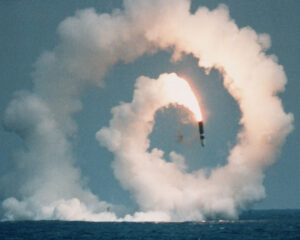
The maiden underwater launch of the Trident II D5 in 1989 was a fiasco that very nearly damaged the launching submarine, the USS Tennessee (SSBN-734). While advancements have fixed the problems and made the missile a vital and dependable component of the sea-based leg of the nuclear triad, having fewer of them at sea in fewer tubes on fewer boats could be a much bigger fiasco. U.S. Naval Institute Photo Archive
Meanwhile, China has added roughly 320 intercontinental ballistic missile (ICBM) silos while expanding every leg of its force, and the Department of Defense projects continued Chinese growth through the 2030s.[3] The November 2024 unclassified nuclear employment strategy report – submitted under 10 U.S.C. §491 and known as the 491 Report – now directs the Joint Force to “deter Russia, the PRC, and [North Korea] simultaneously in peacetime, crisis, and conflict.”[4]
China is building a new sea leg, too. Beijing displayed the JL-3 submarine-launched ballistic missile at its 3 September 2025 Victory Day parade, and now reportedly fields it on board Type 094 Jin-class submarines, giving the People’s Liberation Army Navy (PLAN) its first credible reach against the continental United States from protected waters.[5] A new construction hall at Bohai Shipyard supports the follow-on Type 096 SSBN, which DoD assesses may narrow the acoustic gap with US and Russian boats.[6] Commander, US Submarine Forces, Vice Admiral Richard Seif’s March 2026 testimony before the US-China Economic and Security Review Commission described the supporting architecture: An “Underwater Great Wall” of fixed seabed sensors, unmanned systems, and data fusion designed to detect US submarines and carve out protected bastions from which Chinese SSBNs could hold much of the United States at risk. China’s “near-continuous” deterrent patrols are no longer aspirational.[7]
Nor does the problem stop at the strategic level. Greg Weaver’s April 2025 Atlantic Council study, “The Imperative of Augmenting U.S. Theater Nuclear Forces,” identifies seven attributes that theatre nuclear forces need in a two-peer world and finds the current inventory – dual-capable aircraft in Europe and a handful of low-yield warheads at sea – falling short in nearly every category.[8] Weaver’s remedy, a nuclear-armed, sea-launched cruise missile (SLCM-N) on attack submarines augmented by ground-launched theater missiles, would constitute the most significant addition to US nuclear capabilities since the end of the Cold War.[9]
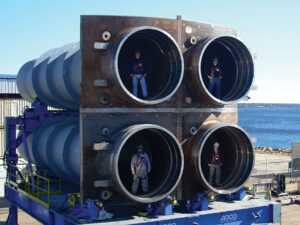
Workers pose for a photo in a four-tube “quad-pack” built for the Columbia-class. Adding an additional quad-pack to later hulls ups the missile capacity per boat from 16 to 20 in much the way the Virginia Payload Module stretched a class already in production. General Dynamics Electric Boat Photo via US Navy
Note where the main burden falls: undersea. The Columbia-class is DoD’s top acquisition priority for good reason. Every credible answer to the two-peer problem runs through the submarine force, dictating the “2 + 1” production cadence – two Virginia-class fast-attack submarines (SSNs) and one Columbia-class SSBN delivered per year.
Survivability Is Earned, Not Conferred
One camp of academic thinking about nuclear weapons rests on a comfortable premise. Robert Jervis gave it canonical form in The Meaning of the Nuclear Revolution, and Kenneth Waltz pressed the theory. Any nation that puts missiles in submarines acquires a secure second strike; mutual vulnerability follows; and further strategic competition becomes futile.[10]
The historical record argues otherwise, and it shows an enduring American edge. Christopher Ford and David Rosenberg’s The Admirals’ Advantage documents how US operational intelligence from World War II through the Cold War fused signals, acoustics, and patrol analyses to hold supposedly survivable adversary submarines at persistent risk.[11] Owen Coté’s The Third Battle tells the same story from the engineering side: the Sound Surveillance System (SOSUS), towed arrays, and a relentless passive-acoustic innovation cycle meant that Soviet boomers spent much of the Cold War trailed by US attack boats Moscow could not hear.[12]
China’s history drives the point home. The Type 092, completed in 1983, never sailed a credible deterrent patrol, and analysts judge Type 094s too noisy to survive open-ocean antisubmarine warfare.[13] A submarine does not buy a second strike. Only a competently operated, quiet submarine does.
The emerging-technology debate sharpens this conclusion. Some analysts warn that new sensors, uncrewed vehicles, and Artificial Intelligence will render the oceans “transparent,” stripping even the best SSBNs of their stealth. Physics counsels skepticism on two fronts. Seawater swallows light, radar, and magnetism within meters, so the nonacoustic sensors that excite the transparency crowd can each search only a sliver of the ocean’s volume – a limit Tom Stefanick quantified decades ago.[14] Sound alone travels far enough to matter, which makes detection a contest the quieter boat wins.
Coté’s survey concludes that today’s quiet submarines will likely stay survivable, and further quieting will likely continue outpacing the sensors hunting them.[15] Read together, those findings cut two ways. The Columbia class’s acoustic margin – the quieting built into each hull (electric drive chief among the improvements) – will buy its survival, not the ocean itself. But, as the Type 096 matures, holding Chinese SSBNs at risk will get harder.
Damage Limitation
The nuclear revolution school draws a policy conclusion from its survivability premise. If no first strike can disarm a state with secure submarines, then deterrence requires only the credible threat to destroy what an adversary values most: its cities, industry, and economic life. Strategists call this a countervalue posture, and scholars from Jervis to Charles Glaser and Steve Fetter have argued that a modest, survivable retaliatory force suffices because anything more wastes money and fuels arms races.[16] The alternative – counterforce – aims weapons instead at the adversary’s nuclear forces and military assets, seeking to forestall the damage an enemy could inflict should deterrence fail.
The United States has weighed these alternatives for 60 years and repeatedly and publicly chosen counterforce. The unclassified 2013 report on US nuclear employment strategy states the position plainly: The United States “will not rely on a ‘counter-value’ or ‘minimum deterrence’ strategy,” and its plans must comply with the law of armed conflict, which prohibits the deliberate targeting of civilian populations.[17]
Geography supplies a deeper reason. Among nuclear powers, the United States alone extends deterrence across discontiguous geography. Its treaty allies sit oceans away in each direction, and a threat to avenge them by incinerating cities – inviting the incineration of its own – rings hollow in Moscow and Beijing and offers cold comfort to Tokyo, Seoul, Warsaw, etc. Credible extended deterrence demands options between surrender and apocalypse, which is why the current 491 Report describes US strategy as “tailored deterrence with flexible capabilities,” credible simultaneously in the Atlantic and the Pacific.[18] That geography also explains why the United States fields the world’s only sea-heavy triad, deploying roughly 70% of its strategic warheads on board SSBNs patrolling both oceans on standing orders.[19]
Counterforce, in turn, levies demands only the sea-based leg fully meets. Forward-deployed Trident boats bring a flexible option no other leg can: prompt, survivable hard-target capability from unpredictable azimuths. A submarine-launched ballistic missile fired from a forward patrol area on a depressed trajectory compresses flight time to a fraction of an ICBM’s, complicating an adversary’s launch-on-warning calculations and holding time-sensitive targets at risk.[20] Every Columbia tube performs double duty – reassuring allies in two theaters with options against two peers and providing the secure reserve that makes everything else credible.
Enter the Tube
The Navy built 14 Ohio-class SSBNs with 24 missile tubes apiece – 336 tubes of design capacity, of which 20 per boat remain operational after New START conversion. Twelve Columbias will carry 16 tubes apiece, netting 192 tubes.[21] The transition surrenders 43% of the sea-based leg’s launcher count – and hull geometry locks in that cut for half a century, the class’s planned service life.
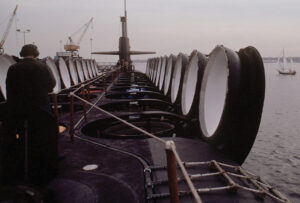
Although the USS Ohio – shown here with her missile hatches open in her original configuration as SSBN-726 – has since been converted to a guided-missile submarine, the tremendous ballistic-missile capacity of the class is obvious. US Navy
The reduction was not careless; it reflected its moment. Navy designers fixed the 16-tube configuration in the early 2010s, when New START ceilings governed, a single peer paced the force, and budget discipline argued for the smallest hull that could do the job. Existing infrastructure constrained the boat’s length. The wharves, dry docks, and refit facilities at Bangor, Washington, and Kings Bay, Georgia, grew up around an Ohio-size hull. The designers spent much of the internal volume opened by fewer tubes on the electric-drive propulsion train and quieting improvements that buy the acoustic margin described above.[22] Each individual trade made sense. Their sum, however, produced a force sized for a world that no longer exists.
The Strategic Posture Commission saw the problem and said so, urging the United States to prepare to upload warheads – increase the number per missile – and pursue capacity beyond the program of record.[23] The upload math is sobering. If the two-peer environment requires more strategic warheads than allowed by current treaty limits – a hypothetical count of 2,000, for example – the Navy and Air Force would put several hundred from the reserve stockpile onto delivery systems. But, with fewer launch tubes, the number of warheads would increase while the total number of missiles afloat would decrease. This would concentrate the arsenal exactly how crisis-stability logic says not to – the risk that a few accurate hits would destroy a disproportionate share of warheads would pressure both sides toward a first strike. The tube deficit thus turns a reversible hedge into a permanent constraint. With the launcher count fixed for so long, uploading stops being an option and becomes the only answer.
The Wicked Problem
Every solution to the tube deficit collides with the same wall: Shipbuilding is the wicked and domineering problem for the submarine force. The two-peer threat demands more capacity at the exact moment the industrial base struggles to deliver the program of record. The District of Columbia (SSBN-826) breached its schedule baseline in November 2024; the Navy and Electric Boat now drive toward a 2028 delivery – roughly a year past the original date – with the boat about 65% complete at the time of writing.[24] Supplier failures in bow sections, turbines, castings, and elsewhere caused the slip, symptoms of an atrophied vendor base the Government Accountability Office flagged years before the first weld.[25]

To paraphrase General Buck Turgidson (George C Scott) in Stanley Kubrick’s 1964 masterpiece Dr. Strangelove: “Mr. President, we must not allow a missile tube gap!” The Cold War–era strategic deterrent was geared toward a single adversary: the Soviet Union. Today’s faces multiple adversaries with fewer hulls and fewer missiles. Uploading more warheads might help – but carries risk. Columbia Pictures
Meanwhile the maintenance backlog for existing submarines compounds the construction problem. With more than a third of the SSN force sidelined awaiting depot work, repair demand spills into the same private yards that must build the District of Columbia.[26]
The money is finally flowing, via an $11.1 billion, five-year submarine industrial base investment plus $3 billion from Australia under AUKUS, but money alone will not hire the builders’ way out of a generational workforce hole.[27] Some pointed suggestions from Proceedings authors and elsewhere deserve acceleration:
Separate repair from construction. Edward Bartlett’s proposal to stand up dedicated component-repair and inland module facilities would de-bottleneck the depot system and return Electric Boat and Newport News to what only they can do: assemble nuclear submarines.[28]
Treat shipbuilders as strategic assets. Sean Stackley’s recounting of past shipbuilding crises lands on a consistent lesson: sustained, predictable demand – multi-year procurement, block buys, and on-time appropriations rather than continuing resolutions – convinces a welder in Groton or Newport News to make a career of it. Josh Tallis pushes further, arguing capital-ship builders are essential services the nation should regulate and capitalise like public utilities.[29] Congress controls these variables completely.
Borrow allied capacity. Jeong Soo Kim and Jeffrey Voth have shown how Japanese and South Korean yards – which deliver on schedule and at scale – could relieve US yards of components, nonnuclear modules, and forward maintenance, much as Australians already turn wrenches on US boats under AUKUS.[30] Pride of sole authorship is a luxury; tubes at sea are not.
Count Tubes, Not Hulls
The first-order solution to the tube problem is unfashionably simple: Build more Columbias. Twelve should be considered a floor derived from single-peer-era requirements, tolerable only because the class’s life-of-ship reactor core eliminates the multiyear midlife refueling overhaul that sidelined the Ohios. Congress should authorise long-lead material for boats 13 and 14 now, while the production line runs hot and the supplier base can plan against a stable one-per-year cadence.
But hulls move slowest. If we count tubes – and we should – faster levers exist. The Columbia’s missile compartment uses common four-tube ‘quad-pack’ modules shared with the United Kingdom’s Dreadnought program. One additional quad-pack in later hulls would recover a quarter of the lost capacity per boat without a clean-sheet design, much as the Virginia Payload Module stretched a class already in production.[31] The Navy could program Ohio-class service-life extensions deliberately as tube-gap mitigation – keeping 20 tubes each at sea – rather than improvise schedule insurance.[32]
The fastest stopgap may already be entering the water. The Block V Virginia boats with the Virginia Payload Module that inherit the retiring SSGN mission – the future Arizona (SSGN-803) among them – add an 84-foot hull section and four large-diameter payload tubes, raising each boat’s cruise-missile capacity from 12 to 40 cells.[33] Fielding SLCM-N in a nuclear-capable fraction of those cells, as Weaver recommends, would let an SSN answer regional crises without risking a 16-tube boomer or its scarce Trident tubes. SLCM-N cannot refloat lost SSBN tubes, but it would buy time and keep the strategic reserve strategic while the shipyards catch up.[34] And sustained investment in the acoustic-superiority ecosystem – arrays, processing, and the operational-intelligence fusion that has been the Navy’s advantage for 80 years – preserves both halves of the US position: US boats survive while adversaries cannot be confident theirs will.
Twelve hulls and call it a day was never going to add up. A second peer plus a smaller, delayed boat equals a tube deficit that will linger 50 years unless the Navy acts soon. The question is not whether the boats will be quiet enough – they will – but whether the nation will build enough, with enough tubes pointed in enough directions, to deter two peers at once. The arithmetic says not yet.
This article originally appeared in the U.S. Naval Institute Proceedings. Copyright U.S. Naval Institute. Reprinted with permission. For more great content from the U.S. Naval Institute, visit www.usni.org.
References
[1] See Valentine Vena, “How to Lose a Thermonuclear War,” pp. 28–32
[2] Congressional Commission on the Strategic Posture of the United States, America’s Strategic Posture: The Final Report (Washington, DC: October 2023).
[3] Office of the Secretary of Defense (OSD), Military and Security Developments Involving the People’s Republic of China 2025 (Washington, DC: Department of Defense, 2025), 65–70.
[4] Department of Defense, Report [to Congress] on the Nuclear Employment Strategy of the United States [491 Report] (Washington, DC: Department of Defense, November 2024).
[5] OSD, Military and Security Developments, 65–67.
[6] OSD, 65–67.
[7] VADM Richard Seif, USN, Commander, Naval Submarine Forces, testimony before the U.S.-China Economic and Security Review Commission, 2 March 2026.
[8] Greg Weaver, The Imperative of Augmenting U.S. Theater Nuclear Forces (Washington, DC: Atlantic Council, Scowcroft Center for Strategy and Security, April 2025).
[9] Weaver, The Imperative of Augmenting.
[10] Robert Jervis, The Meaning of the Nuclear Revolution: Statecraft and the Prospect of Armageddon (Ithaca, NY: Cornell University Press, 1989); and Kenneth N. Waltz, “The Spread of Nuclear Weapons: More May Be Better,” Adelphi Papers 171 (London: International Institute for Strategic Studies, 1981).
[11] Christopher Ford and David A. Rosenberg, The Admirals’ Advantage: U.S. Navy Operational Intelligence in World War II and the Cold War (Annapolis, MD: Naval Institute Press, 2014).
[12] Owen R. Coté Jr., Newport Paper 16: The Third Battle: Innovation in the U.S. Navy’s Silent Cold War Struggle with Soviet Submarines (Newport, RI: Naval War College Press, 2003).
[13] Tong Zhao, Tides of Change: China’s Nuclear Ballistic Missile Submarines and Strategic Stability (Washington, DC: Carnegie Endowment for International Peace, 2018), 26–33.
[14] Tom Stefanick, Strategic Antisubmarine Warfare and Naval Strategy (Lexington, MA: Lexington Books, 1987).
[15] Owen R. Coté Jr., “Invisible Nuclear-Armed Submarines, or Transparent Oceans? Are Ballistic Missile Submarines Still the Best Deterrent for the United States?” Bulletin of the Atomic Scientists 75, no. 1 (January 2019): 30–35.
[16] Jervis, The Meaning of the Nuclear Revolution; and Charles L. Glaser and Steve Fetter, “Should the United States Reject MAD? Damage Limitation and U.S. Nuclear Strategy toward China,” International Security 41, no. 1 (Summer 2016): 49–98.
[17] DoD, Report [to Congress] on the Nuclear Employment Strategy of the United States [491 Report] (Washington, DC: Department of Defense, June 2013).
[18] DoD, 491 Report (2024).
[19] Hans M. Kristensen, Matt Korda, Eliana Johns, and Mackenzie Knight, “United States Nuclear Weapons, 2025,” Bulletin of the Atomic Scientists 81, no. 1 (January 2025).
[20] Lisbeth Gronlund and David C. Wright, “Depressed Trajectory SLBMs: A Technical Evaluation and Arms Control Possibilities,” Science & Global Security 3, no. 1–2 (1992): 101–59; and DoD, 491 Report (2024).
[21] Kristensen et al., “United States Nuclear Weapons, 2025”; and CRS Report R41129: Navy Columbia (SSBN-826) Class Ballistic Missile Submarine Program—Background and Issues for Congress (Washington, DC: Congressional Research Service, 2026).
[22] CRS Report R41129.
[23] Congressional Commission, America’s Strategic Posture.
[24] Sam LaGrone, “Navy Says Columbia-Class Sub Construction Schedule Improving,” USNI News, 11 February 2026; and CRS R41129. The original delivery date was October 2027; the Navy’s FY27 budget submission reflects a March 2029 estimate, while the program target remains 2028.
[25] Government Accountability Office, GAO-21-257: Columbia-Class Submarine: Delivery Hinges on Timely and Quality Materials from an Atrophied Supplier Base (Washington, DC: Government Accountability Office, 2021).
[26] Edward L. Bartlett Jr., “The Navy’s Submarine Maintenance Crisis Needs Ready, Affordable Solutions,” U.S. Naval Institute Proceedings 150, no. 1 (January 2024).
[27] CRS Report R41129; and Sean Stackley, “Never Let a Good Crisis Go to Waste,” U.S. Naval Institute Proceedings 151, no. 6 (June 2025).
[28] Bartlett, “The Navy’s Submarine Maintenance Crisis.”
[29] Stackley, “Never Let a Good Crisis Go to Waste”; and Joshua Tallis, “Treat Naval Shipbuilders Like Public Utilities,” U.S. Naval Institute Proceedings 152, no. 6 (June 2026).
[30] Lt Jeong Soo Kim, USNR, “Lessons from Japan and South Korea’s Submarine Builders,” U.S. Naval Institute Proceedings 151, no. 6 (June 2025); Lt Jeong Soo Kim, USNR, “Use Allies in Shipyard Modernization,” U.S. Naval Institute Proceedings 149, no. 5 (May 2023); and Jeffrey M. Voth, “Rebuilding the Navy Will Require Allied Industrial Power,” U.S. Naval Institute Proceedings 152, no. 6 (June 2026).
[31] CRS Report R41129.
[32] LaGrone, “Navy Says Columbia-Class Sub.”
[33] Ronald O’Rourke, CRS Report RL32418: Navy Virginia-Class Submarine Program and AUKUS Submarine (Pillar 1) Project: Background and Issues for Congress (Washington, DC: Congressional Research Service, updated 2026).
[34] Weaver, The Imperative of Augmenting; and CRS Report IF12084: Nuclear-Armed Sea-Launched Cruise Missile (SLCM-N) (Washington, DC: Congressional Research Service, updated 2026).
