More Than a Warfighter

With Commodore Matthew Perry USN as a case study, the author, associate professor of war studies and naval history at the US Naval Academy, makes the case for maritime balance in the character of the professional naval officer. Originally published in the USNI’s Proceedings, September 2026. A 15 minute read.
A sailor in 2026 cannot go more than a day without being assured he or she is a ‘warfighter’. It is in the zeitgeist of the US Navy, as well as that of the wider Department of Defense. The department has even adopted secondary names to highlight ‘war’ and concerns about ‘the warrior ethos’ have become ubiquitous. The looming potential for armed conflict with China remains foremost on the minds of naval professionals; the so-called Davidson Window for maximum threat remains open.[1] Former Chief of Naval Operations Admiral Lisa Franchetti’s final Navigation Plan assured us that ours is a “warfighting navy.”[2]
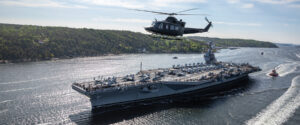
Norwegian air and naval escorts guide the aircraft carrier USS Gerald R. Ford (CVN-78) through the Oslo fjord, Norway, for a port call in May 2023. The Gerald R. Ford was the first US aircraft carrier to visit Norway in more than 65 years. Building and sustaining alliances has been a mission of navies for centuries. US European Command (Onar Digernes Aase)
Yet, in this same era, a bipartisan vote in Congress revised the Navy’s mission. For more than half a century, Title 10 of the US Code directed that mission be preparation for, and prosecution of, war. In 2022, elected representatives of both political parties – led by Wisconsin Republican Representative Mike Gallagher – assigned an additional responsibility: “Promote the national security and prosperity of the United States in peacetime.”
Despite the formal change in the mission, today’s officers and sailors hear a lot about being a warfighter and much less about what it means to defend the nation’s security and prosperity in peacetime. While the law has expanded to account for a full view of the Navy’s historical and contemporary missions, naval culture is narrowing its focus. The naval profession demands combat leaders who will fight and win the nation’s wars at sea – but also a great deal more. Being a ‘warfighter’ is necessary, but insufficient.
Navies across time have had roles far more expansive than preparation for combat operations. For generations, the Royal Navy provided not only the wooden walls that protected England, Scotland, and Wales, but also the global peacetime operations that maintained an empire diplomatically and economically. Centuries ago, the Venetian and Athenian navies fought for their nations, but they also conducted maritime security operations and collaborated with maritime industries – and sailed on missions that included geopolitical deterrence as well as economic development and diplomatic leverage.[3]
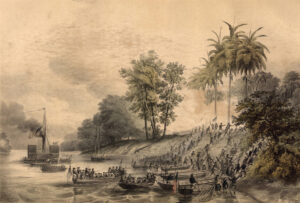
Matthew Perry helped lead multiple amphibious landings during the Mexican-American War, including the amphibious attack on Tabasco, Mexico, shown here. Perry’s March 1847 amphibious landing at Vera Cruz was the largest amphibious assault the United States had ever attempted. THS Oversize Collection
The history of the US Navy and its leaders demonstrates that naval professionalism has always included success at influencing the world through diplomatic, informational, and economic means as well as in combat. The long service of Commodore Matthew Perry, hero of two wars, technological innovator, and economic and diplomatic groundbreaker, exemplifies the kind of balanced naval professional critical to America’s rise. The same kinds of talents and abilities will be vital for continued success in the nation’s next century.
An Innovative Officer
Matthew Calbraith Perry was a 17-year-old midshipman when war with Britain broke out in 1812. He served under several of the great leaders of the era, including Commodores John Rodgers and Stephen Decatur. As a division officer, he trained and operated with his gun crews and learned the ropes of a ship at sea. In 1815, as the war came to an end, he was immediately redeployed to the Mediterranean for the Second Barbary War. By the time he had been in the Navy for ten years, he had served in two conflicts, commanded his first ship, and laid the foundations of his professional knowledge and abilities.[4]
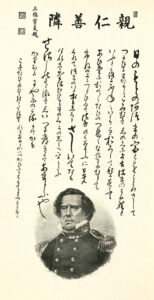
Perry is most famous for his two expeditions to Japan, which were a mix of martial threat and careful diplomacy. The title of this 19th century woodcut can be translated as “Be close to benevolence; be good to neighbors.” University of Texas at Arlington
In the 1820s, the United States began to grow its global commercial enterprise. Merchants sailed throughout the world, carrying US cargoes and making money in international trade. But commerce required protection, and peacetime responsibilities began to mount. In addition to preparing for war, Perry and the Navy began to understand the peacetime economic and diplomatic obligations that came with being a maritime power.[5]
During this time, Perry experienced the wide responsibilities of a naval officer. Serving with the West Indies Squadron, he was part of counterpiracy and maritime security missions. In command of the frigate Cyane and the schooner Shark, he fought pirates, hunted slavers, and collaborated with British and Spanish forces. He commanded small combatants and served as the first lieutenant (today’s executive officer) of the 102-gun North Carolina, then the Navy’s largest battleship. He honed the warfighting skills of his crews, who also practiced their peacetime responsibilities and pursued national objectives. He helped lead the squadron that carried Black American colonists to establish what today is the country of Liberia. He conducted diplomatic missions in the Mediterranean, including negotiating a dispute over claims between US merchants and the government of Sicily. And he worked with US diplomats.[6]
Assigned to the Brooklyn Navy Yard in 1833, Perry became an intellectual leader as well as a deckplate and operational one. With a group of like-minded reformers, Perry established the Naval Lyceum, a forerunner of the US Naval Institute. Hosting lectures and discussion groups and building a library for the professional development of the officer corps, the Lyceum also launched The Naval Magazine.[7]
Methodical, critical of the status quo, and ready to try new approaches, Perry and his fellow innovators debated the development of steam propulsion, the future of explosive shells, and the strategic future of the United States as a great power. They also studied the peacetime responsibilities of navies, the service’s relationship with the US maritime community, and the necessity for more formalised officer education and professional development. Their hard thinking and debate foreshadowed the changes that would be needed as the 19th century progressed.[8]
Perry was eventually rewarded with command of the Fulton II, the Navy’s first ocean-going steam warship. In many ways, the ship was a failure – but one whose growing pains taught Perry numerous lessons. He was then able to influence the construction of the follow-on vessels Mississippi and Missouri, helping to make them more effective and efficient.
But adoption of steam power was not the only development to come out of the Lyceum. The formation of the US Naval Academy followed in the 1840s, and Perry joined a board that reviewed the early curriculum. The willingness of officers to write and speak about their profession also contributed to a rising recognition that a nation with international trade required protection and international presence in peacetime. This resulted in political support for a growing fleet, even without a looming threat of war.[9]
An Operational Commander
For Matthew Perry, the 1840s were another mixed experience of peacetime operations and warfighting as he returned to sea duty. Following the Webster-Ashburton Treaty between the United States and Britain, Perry was placed in command of the West Africa Squadron to enforce the ban on the slave trade and protect US commerce in Africa. Perry had to bring together operational, diplomatic, and economic abilities. Limited supply basing, the danger of Yellow Fever, and the small size of his force relative to the massive African coast all offered challenges he needed to address in a peacetime role. In addition to pursuing and capturing slavers, his ships protected the settlement at Liberia, exacted revenge for attacks on US interests, and negotiated relationships with local leaders.[10] Results were mixed, but his innovations in crew health and welfare – and his operational thinking about the use of steam power – charted new courses for the Navy.
In 1846, the United States went to war, this time with Mexico. At first, he served as the deputy commodore to David Conner, helping lead the amphibious landing at Vera Cruz in 1847 and sending Navy gun crews ashore with the Army artillery units to ensure the success of the operation. It was the largest amphibious assault the United States had ever attempted. He later took over as commodore and led raiding operations up Mexico’s rivers to threaten the cities and towns of the coast. He blockaded ports to seal off the possibility of supplies and material support reaching Mexico, and he sent his Marines to Mexico City alongside the Army. He was the most senior combat commander in the US Navy, and he ensured that General Winfield Scott’s march to Mexico City met little resistance.[11]
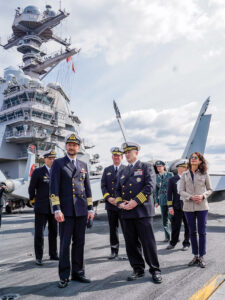
Norway’s Crown Prince Haakon on board the aircraft carrier Gerald R. Ford in 2023. The interplay of warfighting readiness and peacetime defence of security and prosperity has long been recognised. In May 1914, Rear Admiral Bradley Fiske wrote in Proceedings, “The past few years have given navies more and more a diplomatic character…. [One] cause is the stabilising effect on international relations of the modern practice of maintaining navies in a state of constant readiness for war.” Royal Norwegian Court (Liv Anette Luane)
Following the US victory, Perry had earned a reputation as one of the Navy’s most accomplished officers. He was not known for bravado or showmanship. He was not beloved out of popularity or looked upon as a great hero. Instead, as one of his fellow officers wrote, he was “the most industrious, hardworking, energetic, zealous, preserving, enterprising officer of his rank.”[12] At its core, Perry’s reputation in the Navy was based on respect and quiet professionalism in both combat and peacetime roles.
A Diplomat and Economic Leader
Outside the Navy, Commodore Perry is best known for naval diplomacy and his efforts to ensure US economic prosperity and security in the Pacific. For centuries, Japan had been a closed society, rebuffing all efforts from external forces and diplomatic gestures. In the 1840s, two naval missions had sailed for Japan to recover shipwrecked Americans. Neither was able to establish a formal relationship with the islands, but both returned firmly believing in the need for a diplomatic mission to open Japan. President Millard Fillmore selected Perry to lead one.
In contrast to the leaders who had been dispatched in the past, Perry took time to prepare for the operation. In 1852, meeting with naval officers who had sailed to the western Pacific, visiting with New England whalers who had worked those seas, and corresponding with scholars from all over the world, Perry learned as much as he could about Japan’s culture and political system. He spent time strategizing about the diplomatic approach he would take, the gifts he would bring the Emperor and other Japanese leaders, and the practical requirements of surveying and mapping the islands.[13]
In November 1852, Perry sailed with dual orders from the Department of the Navy and the Department of State. From the latter, his mission was to negotiate a treaty that would protect American seamen and ships that were wrecked or fleeing hazardous weather; allow for US ships to obtain water, provisions, and repairs in Japan; and open at least one port to US trade. The Navy tasked the expedition with surveying Japan’s coastal waters. Sailing on board the Mississippi – the steam warship he had helped design – Perry and his squadron carried out his careful plan over the next two years.
Gathering his ships on the Chinese coast, Perry worked methodically through this plan. First, he established a relationship in the Ryukyus by sailing to Okinawa, negotiating with the Regent, and establishing a base of operations. He also sailed to the Bonin Islands and visited a settlement and supply base established by a New England whaler at Port Lloyd, lending official US legitimacy to the effort. It was not until July 1853, with his crews well drilled and experienced in the western Pacific, that Perry sailed for the Bay of Edo (modern-day Tokyo Bay) to begin his direct negotiations with Japan.
There, Perry orchestrated a mix of naval diplomacy, gift and cultural exchange, and implicit threat from the heavily armed ‘Black Ships’ of his squadron. While much of what he had learned about Japanese politics and culture was inaccurate – or transmitted through a Western prism that caused misunderstanding – enough was correct that he could navigate the negotiations better than the leaders of previous efforts. After delivering President Fillmore’s letter to the Emperor requesting negotiations for a treaty, Perry left Japanese waters to give Japan’s leaders time to consider the overture. He told them he would return the following spring.[14]
When he returned, Perry brought an intimidating squadron twice the size of that of his original visit and bristling with guns. In the interim, five commissioners had been appointed to begin discussing a treaty. Formal negotiations lasted months. However, in the end, Perry successfully completed the Treaty of Kanagawa, which accomplished all three elements of his orders and established Shimoda and Hakodate as ports where US merchants could trade. Following the negotiations, Perry returned to Okinawa, where he signed a treaty of friendship with the Regent. He returned to a hero’s welcome at home.[15]
Matthew Calbraith Perry was the most respected US Navy officer of his era. Historian John Schroeder wrote that Perry “inspired neither great love nor hero worship. Instead, he earned the respect of his contemporaries through hard work, sound judgement, and effective performance.”[16] Beyond any shadow of a doubt, Perry showed he was a great warfighter.
But Perry was also much more. He was an intellectual leader, a technological innovator, and a diplomat and defender of the global economic system and maritime security. He helped develop exploding shells and screw propellers, negotiated treaties, led antipiracy and antislavery patrols, and collaborated with partners and allies.
Not Only Warfighters
Perry exemplifies what it means to be a naval professional. We naval officers are necessarily warriors who stand ready to fight and win the nation’s wars. However, we are also peacetime defenders of US interests. We have the historic and legal responsibility to promote the national security and prosperity of the nation. As the 2007 Cooperative Strategy for 21st Century Seapower put it, “Preventing wars is as important as winning wars.”[17] The skills, abilities, and operational experience needed to be able to conduct both types of missions – wartime and peacetime – are often related. But they are not identical.
Focusing only on one while leaving the other to atrophy results in strategic misunderstanding and failure. When all challenges – from maritime security and law enforcement missions to diplomatic opportunities – are classified as ‘wars’, the wrong tactics, techniques, and procedures get applied. These may result in the appearance of short-term success but the reality of long-term failure to protect US security. It can lead to degradation of operational capabilities and strategic purpose, as well as an abdication of the responsibilities the Navy has to the American people.
In the Red Sea, the Persian Gulf, the eastern Mediterranean, and the Strait of Hormuz over the past several years, the US Navy has again proved itself a lethal warfighting force. In the most intense naval combat since World War II, the downing of hundreds of missiles and drones without any successful attacks on US ships has shown a capability and professionalism all sailors should be proud of. Ships in the Seventh Fleet continue to conduct freedom-of-navigation operations in the Indo-Pacific; Sixth Fleet collaborates with European allies in the Baltic and Mediterranean; and naval diplomacy through forums such as AUKUS and the Quad strengthen US interests.
Calling sailors ‘warfighters’ is not enough. They certainly are a lethal maritime force and will continue to train and practice for the possibility of war. But they also must continue to carry out the diplomatic, economic, and security missions that defend US interests all over the globe. They are warfighters, and they are defenders of the peace. As with Matthew Perry and the generations of US sailors who have sailed the world’s oceans to serve the American people, today’s sailors’ responsibilities are varied and hard to balance. But doing hard things has always been what makes the people of the US Navy different. Today’s officers and sailors are more than war-fighters. They are the complete naval professionals they have always been.
This article originally appeared in the U.S. Naval Institute Proceedings. Copyright U.S. Naval Institute. Reprinted with permission. For more great content from the U.S. Naval Institute, visit www.usni.org.
References
[1] Mallory Shelbourne, “Davidson: China Could Try to Take Control of Taiwan in ‘Next Six Years,’” USNI News, 9 March 2021. ADM Phil Davidson defined the timeline but did not use the phrase.
[2] ADM Lisa Franchetti, USN, “Navigation Plan for America’s Warfighting Navy Underway, Gaining Speed,” U.S. Naval Institute Proceedings 151, no. 3 (March 2025).
[3] Andrew Lambert, Seapower States: Maritime Culture, Continental Empires, and the Conflict That Made the Modern World (New Haven, CT: Yale University Press, 2018), 8–16.
[4] Samuel Eliot Morison, Old Bruin: Commodore Matthew C. Perry, 1794–1858 (Boston, MA: Little, Brown and Company, 1967), 35–60.
[5] John Schroeder, Shaping a Maritime Empire: The Commercial and Diplomatic Role of the American Navy, 1829–1861(Westport, CT: Greenwood Press, 1985).
[6] William Elliot Griffis, Matthew Calbraith Perry: A Typical American Naval Officer (New York: Houghton, Mifflin and Company, 1890), 65–80.
[7] Constitution and Bylaws of the United States Naval Lyceum: Established at the Navy Yard, New York (Brooklyn, NY: E. B. Spooner & Co., 1838).
[8] Claude Berube, “The Crucible of Naval Enlightenment,” Naval History 28, no. 5 (October 2014).
[9] John Schroeder, Matthew Calbraith Perry: Antebellum Sailor and Diplomat (Annapolis, MD: Naval Institute Press, 2001), 80–87.
[10] Griffis, Matthew Calbraith Perry, 167–82.
[11] Morison, Old Bruin, 215–49.
[12] Franklin Buchanan, quoted in James Bradford, Quarterdeck and Bridge: Two Centuries of American Naval Leaders(Annapolis, MD: Naval Institute Press, 1997), 112.
[13] Schroeder, Matthew Calbraith Perry, 154–83.
[14] Kenneth Hagan, This People’s Navy: The Making of American Sea Power (New York: The Free Press, 1991), 148–49.
[15] Matthew Calbraith Perry, The Japan Expedition, 1852–1854: The Personal Journal of Commodore Matthew C. Perry, ed. Roger Pineau (Washington, DC: Smithsonian Institution Press, 1968).
[16] John Schroeder in Bradford, Quarterdeck and Bridge, 112.
[17] James Conway, Gary Roughead, and Thad Allen, “A Cooperative Strategy for 21st Century Seapower,” Naval War College Review 61, no. 1 (Winter 2007): 7–19.