What the 400th anniversary of the French Navy highlights for Franco-British naval relations

For Bastille Day, the author considers the past and future of the relationship between the Marine Nationale and the Royal Navy, a vital pillar in the European defence architecture. With a foreword by the First Sea Lord. A 20 minute read.
The 400th anniversary of the Marine Nationale is not only a historic moment for France – it is a milestone for all of Europe, one which the Royal Navy marks with the respect and friendship it deserves.
For four centuries, the Royal Navy and the Marine Nationale have shaped one another. We were once competitors and enemies. We fought for dominion over the world’s oceans.
Today, our relationship is altogether different: we are close friends and allies, bound together by two World Wars, our shared interests and values, our economies, and by our status as Europe’s two leading naval powers.
Our shared history is intertwined in a way few other nations can claim. It is rooted in sea power, which has always been central to both Britain and France’s security, prosperity and the influence we continue to exert around the world.
That history will also determine our future together. In an age of renewed state-on-state contest, rapid technological change and growing threats to the Euro-Atlantic, the relationship between our Navies matters more than ever.
The 1998 Saint Malo Declaration set the foundation for stronger UK-French defence cooperation. Since then, we have gone from strength to strength. Our frigates have participated in each other’s carrier strike groups. Our sailors, officers and staffs serve alongside one another through exchange postings and embeds. Our Navies train together, plan together and operate together. Our Type 45 destroyer, HMS Dragon, has recently integrated with the French carrier strike group in the Gulf.
Today, the Royal Navy and Marine Nationale are both adapting to a new era of drones, autonomy, digital networks, advanced weapons and hybrid operations. We share technology, ideas and ambition because we face the same hard truth: the next fight will be faster and more complex than the last. We need each other to succeed.
The threats we face are shared. So too must be our response. The next chapter of UK-French naval cooperation must be even closer. If our two Navies continue to align our vision and integrate our strengths, we will remain at the heart of Europe’s maritime security. Ready to deter our adversaries. And should it be required, ready to lead, fight and win.
Together.
General Sir Gwyn Jenkins, First Sea Lord and Chief of Naval Staff
****
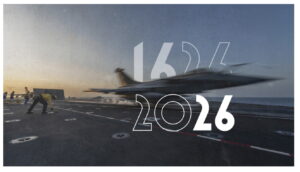
Under the French Chief of Naval Staff’s initiative, the French Navy is celebrating its 400th anniversary this year. The founding momentum is remembered as the ‘Edit de Saint Germain’ setting up the ‘Marine Royale’ in 1626, signed by King Louis XIII’s main minister, Cardinal de Richelieu. Since then, the French Navy has pursued its development in persistent interaction with the Royal Navy – often in competition, yet frequently in cooperation. In today’s strategic context it’s interesting to look astern to better understand our different choices and mutual influence, where our paths have diverged, but also to examine the future challenges we will have to face together as the two European leading Navies. The growing number of crises commends, as with previous times in our history, to focus on how to align our efforts and strengthen our collective value for our European Allies. We will focus here on the most sensitive urgencies our Navies have to address in terms of drones, munitions and interoperability, but also consider in the longer term means for better alignment and what finally really matters to ensure enduring maritime security for our old continent.
The shared history between the two navies began long before this founding date of 1626. Indeed, the Kingdom of France reached the shore of the Channel in 1204 with the conquest of the Duchy of Normandy, and therefore the competition for the sea soon became a challenge. First, by the necessity for England to keep sea lines of communications open with her possessions on the continent, underpinned by the battle of Sluys in 1340 at the beginning of the Hundred Years’ War. Later, global exploration and expanding maritime trade intensified competition. These challenges culminated in 1626 at the siege of La Rochelle, highlighting the need for a unified French Navy under the king’s command. This was followed by key periods in the Franco-British naval relationship:
1629 – 1688, birth of the French Navy and first Anglo-French Alliance
After the successful siege of La Rochelle where the lack of sea dominance was pointed out as a real weakness for France, a peace treaty was signed, both for internal political reasons and to prevent a growing Dutch power to dominate European trade (highlighted by the battle of Solebay in 1672). This period enabled both Navies to consolidate their fleets and modernise their organisations. On the French side, it was the time of the ‘major royal ordinances’ establishing the royal cadet corps for the training of young officers, a formal organisation for the shipyards, and a global steering organisation for the naval armies. The French Navy took benefit of (i) a relative peace time allowing relevant planification and significant funding and (ii) a strong leadership from forward-thinking chiefs such as Richelieu and Colbert. The vision of such statesmen, planting huge oak forests at the heart of the kingdom resonates today when deciders struggle to keep open the importation chain for steel, rare earth and other critical materials.
1689 – 1815, second One Hundred Years’ War
This shift stemmed from domestic political changes in England and increasing fear regarding Louis XIV’s expanding power. England sorted out its internal problems, becoming a powerful United Kingdom able to challenge continental states. The Nine Years’ War was the first in a long century of confrontations which ended with the Congress of Vienna in 1815. For France, Revolutionary executions and Napoleonic Wars buried her ambition to be the leading European power. On a strategic perspective, it underlined the foremost importance of sea power for a modern State. It has also shown the rise of alternative strategies to be able to circumvent a maritime superpower in times where the continental threat was prominent: Vauban came up with the idea of irregular war, launching the concept of privateering and paving the way to today’s private military companies.
1815 – 1956, reconciliation and modernisation
After 1815, Britain and France quickly realigned around shared interests. Firstly, to limit Russia’s expansion towards open seas and safeguard the balance of powers (battle of Navarino, 1827, and Crimean War, 1854-1856). And thereafter with the Entente Cordiale in 1904, built to overcome former colonial disputes, but which paved the way to the Triple Entente of World War I. For the French Navy, any form of confrontation with the Royal Navy was then ruled out, considering both the gap in force balance and moreover the rising imperialism coming from the East, Germany first and then the Soviet Union. Leveraging the Pax Britannica ruling the oceans from 1815 to 1914, both French and Royal Navies initiated deep modernisation in a healthy innovation contest with the step from sail to steam, explosive shells, armoured vessels, torpedoes, launching of the first submarines, but also on gunnery systems: breech loading, fire control and range finding. Amidst this technological boom, which bears a striking resemblance to the one we are experiencing today, it may not be the fastest that comes out on top. Even if France was first in launching an armoured vessel (La Gloire) in 1859, only the Royal Navy (and then the German one) managed to scale up the concept in a relevant Grand Fleet of dreadnoughts in the Fisher moment. On a more operational perspective, this reconciliation is embodied by the gearing of pre-war plans based on burden sharing between the Northern and the Mediterranean seas. This did not prevent Joint Operations in these areas, such as at the Dardanelles (1915) and Narvik (1940), where both navies fought side by side even if the strategic outcomes were not those expected. Based on these first experiences, French and Royal Navies achieved to plug and fight together during World War II, when interests converged. The most brilliant examples of these common operations are Kieffer’s commandos landing alongside British soldiers on Sword Beach and the Provence landing where the French Navy bombed the German defences along with her Ally.
Since 1956, the nuclear deterrence era and the NATO framework
The Suez crisis (1956) which was on the tactical side a true achievement in naval bilateral cooperation, has in fact revealed the decline of both French and UK influences in the great powers’ game. However, it highlighted different strategic choices between both sides of the Channel, providing somehow a fair complementarity to North Atlantic security. Where London chose to strengthen its transatlantic relationship to avoid repeating such a misunderstanding with Washington, Paris preferred to take the path of full and complete strategic autonomy, advocating for a third way: A stronger Europe between the two blocks. For the French Navy, the direct impact of this shift has been the commitment to a fully independent nuclear strike force and the withdrawal of the integrated NATO Command Structure. Despite these two different approaches considering the relationship with the USA and NATO, both Navies have kept similar designs: ambitions to remain global, nuclear, able to respond quickly to crises and considering maritime power as a strong diplomatic lever. Both Navies faced similar challenges in this post‑colonial era, during which Carrier Strike Groups proved decisive as assets for rapid deployment of power. To support Djibouti’s independence in the ‘70s or the Lebanon and Gulf crises in the ‘80s, and Yugoslavia Wars in the ‘90s, the carriers have been key players for France, as they were for the UK in Belize, the Falklands and Bosnia. And lastly, since the ‘60s, both Navies have similarly integrated Joint Ministries of Defence, giving up their singularity to achieve greater Joint effectiveness, though French integration may have gone further up to now in the areas of operations and acquisitions.
The challenges of a new security era
Looking back at this history enlightens the future perspectives towards building pragmatically on our common strengths, while also maintaining a clear-eyed view on our individual interests, and without falling into unproductive initiatives for the sole sake of cooperation. Indeed, the development rate of both Navies may have cumulated when cooperating against a common competitor at the verge of war, in an era of relative peace in the 17th, or 19th centuries, when common interest prevails and meets our individual interests and competition produced a positive outcome. Such a posture is embodied today by the series of Lancaster House Treaties (2010 and 2025), of which the three nuclear, operational and industrial pillars have a direct impact on our Navies’ mutual cooperation. They also highlight the preeminent role of the French and the Royal Navies, the only nuclear navies in Europe, carrier capable and possessing global ambition.
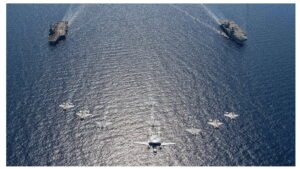
Dual carrier operations between Charles de Gaulle and Queen Elisabeth carriers in 2021 in the Mediterranean Sea
Sticking to everlasting Clausewitzian principles
Turning back to Clausewitz’s ‘trinity’,[1] described by Marshal Foch with regard to Armed Forces as the combination of material, conceptual and morale strengths, one should consider if all its dimensions are covered to achieve a strong and effective partnership.
Material. In recent years, in the naval capabilities’ realm, significant successes have been achieved in Franco-British cooperation. First, in terms of nuclear research, notably on warheads, then through the co-development of anti-missile system onboard Air-Defence Destroyers. In both areas, there are obviously many opportunities for future cooperation as Europe moves towards a more independent defence development.
The cooperation around a common carrier was close to reaching its end, however, the two main directions taken by the French and the Royal Navies seem to be slightly different. As the first is launching a new nuclear carrier program which will impact its fleet design by 2080, the second is shifting towards a more hybrid concept. Indeed, while both Navies are focusing on drone development in the three environments, where capability cooperation between the two Nations is a necessity, the Royal Navy’s ambition is to push the concept on a larger scale. This raises the challenge of interoperability if those directions are confirmed, and the opportunities of interchangeability if we manage to get more aligned with regard to future drone concepts. In both cases, the digital backbones behind both choices will need to be closely developed in relation with NATO to ensure interfaces remain compatible with the growing number of crewed/uncrewed systems about to reach our fleets.
This unmanned systems’ rising concern in terms of massification and interoperability to address today’s challenges must be inspired by what UK and France have already built together in the MCM domain. The current Iran crisis and the need to reopen the Strait of Hormuz highlights the sharp relevance of these system-of-systems approaches,[2] set up ten years ago when only few specialists were then considering unmanned surface systems as a possible future. The current ambition of France and the UK to shape a dedicated defensive mission to help reopen the Strait must pave the way to a future of common hybrid operations carried out shoulder to shoulder.
In similar future scenarios, interoperability through standardised interfaces for payloads and launch and recovery systems, access to common spare parts and ammunition stockpiles, strategic lift of unmanned assets or ultimately common data sharing procedures, will be mandatory and must be addressed today.
Indeed, another challenge of the material domain, highlighted by the Ukraine War, the Red Sea events in 2024, and more recently the war in Iran, is the overstretching of our stockpiles. The existence of common weapons[3] is necessarily an incentive and a facilitator for this area, and synergies have already been applied for mutual support and industries have started ramping up, but more is needed now. Addressing this issue is today’s urgency for European countries, and needs to continue challenging the means for design, production and the acquisition of ammunition. In this perspective, we could consider relevant burden-sharing between allies, including plans to leverage industries’ own capabilities. The partnership set last year between Renault and the French MoD to scale up drone production is a good example to build on. It highlights the need, not to create stocks which will be outdated in less than six months, but to upkeep the possibility and the ability for industry in both Nations to switch to a form of war support model at pace.
Doctrine. Current crises near Europe’s borders challenge long‑standing assumptions about collective defence activation. Indeed today, who could be assured of the conditions of an Article 5 trigger? Once again, the Chequers’ declaration in 1995 figuring out the imbrication of our vital interests is a strong message upon which could be built future cooperation frameworks and steadfast messaging to allies and adversaries. Additionally, the Northwood Declaration in 2025 clearly includes European interests in general under the nuclear cover, which was confirmed earlier this year by the French concept of Forward Deterrence. In addition to NATO, the Coalition of the Willing (CotW) framework and the Franco-British Combined Joint Force (CJF) are relevant and effective constructs to strengthen the network and address the question of nuclear deterrence. But if our nuclear deterrence is the cornerstone of our defence, we must care about the pillars that sustain it. Thus, for the Navy, this means to relentlessly uphold strong links in anti-submarine warfare, mine hunting and seabed surveillance. As autonomy and modularity is somehow driving the future of any warfare domain, France and the UK must stay aligned on their hybrid doctrines and concepts to control the deep seas in the North Atlantic in coming years.
Morale strength. Moreover, the people dimension with its essential necessity of fighting spirit, is the foremost condition for victory. Fighting spirit in the Armed Forces must not be reduced to the modern term of resilience as it is more rooted in culture and morale, rather than only shock absorption capacity. Both the First Sea Lord, with his recently published ‘Warfighting Ready Plan’, and the French Chief of Naval Staff (CEMM) with his plan ‘Marins de combat’ have emphasised this dimension – as Napoleon said, “In war the moral is to the physical as three to one.” These morale strengths, following General de Négrier’s definition, could be summarised as (i) determination to win, (ii) mutual trust (and in one’s chiefs), (iii) physical fitness, (iv) patriotism, (v) morale education, (vi) tradition and inborn instinct.[4] So many standards still shared and deeply rooted in the British and French Armed Forces whose origins could be found in a long-standing European culture, explaining why our People Exchange Program is successful.
Thus, and without wishing to offend our other Allies, the Franco-British naval tradition – which is still evident today in high-end operations such as those in the Red Sea – demonstrates that our two Navies possess that extra spirit which others will take time to build up, and which ensures that we remain at the forefront of European naval defence. However, one should not forget that the challenge of mutual trust as the perspective of the necessity to fight shoulder to shoulder is looming. It can only be built through common training on a regular basis, cemented by mutual knowledge to be upkept – and these occasions are today unfortunately too rare for the Navies. Whilst Europe’s security architecture needs to be thoroughly rethought, one must keep this in mind when building a new defence system for our continent.
Conclusion
As our continent enters a decisive era marked by renewed maritime contestation, and the return of high intensity conflict as a probable hypothesis, the Franco-British naval partnership stands as one of the ultimate pillars of strategic stability in Europe. It is a responsibility forged by our shared history, elevated by high standards like nuclear skills and capacities, and validated every day through the operational behaviour of our two Navies across the world – from the North Atlantic to the Indo-Pacific.
Yet the challenges we face extend far beyond material power. They demand clarity and a shared will to shape the environment rather than react to it. They require France and the United Kingdom to assume their role as Europe’s maritime Navies of reference: able to deter, to lead, to fight, and to win. Their shared operational culture, combined with the development of the assets owned by other major partners in Europe (Germany, Nordic states, Italy, Greece, amongst others), can bring the European pillar of the Alliance to the level of effectiveness expected both by our transatlantic partners and our own populations.
It also requests courage, a virtue that must be embraced far beyond the battlefield and thus understood as a strategic posture: the courage to think beyond national interest when European security is at stake, the courage to educate our political chiefs on defence issues, and last but not least the courage to not remain hidden behind laws and rules, especially in today’s time, when the RBIO is in rubbles and demands us to think outside of the box.
In this sense, the following words resonate with meaningful force today: “In the modern world, there are so many forces arrayed against humanity that the fate of mankind ultimately depends more on the virtue of courage than on mere knowledge.”[5] If the Marine Nationale and the Royal Navy choose to align their visions, pool their strengths, and reinforce the trust built over centuries, they will remain the leading European naval actors capable of shaping the maritime balance of power in the four hundred years to come.
References
[1] Setting that war is shaped by the articulation of politic, force and people in the wiling confrontation with the enemy.
[2] The MCM bilateral program was decided in 2010 as part of Lancaster House treaties. It is known as SLAM-F in France and MMCM in the UK.
[3] As Storm Shadow and Aster missiles – or the future STRATUS program – for the complex weapons.
[4] « Le Moral des troupes », in Revue des Deux Mondes, no. 25, 1905, by Général de Négrier, 1839-1913.
[5] Maréchal de Lattre de Tassigny
